We haven't really had much of a summer this year - rainy month has followed rainy month, and July (by and large) seems to be no exception.
Despite this, veg on the allotment and at home continues to flourish.
I'll begin at home.

Cucumber.
This really wet weather doesn't seem to suit cucumber plants, as the leaves don't look too healthy . That said, the one or two cucumbers (the actual vegetable) we have are growing well, and we've got some others are beginning to develop from flower. 
New cucumbers growing.

Strawberries.
We've had more success with the strawberries we're growing, but this is tempered by the fact that slugs seem to enjoy eating them just as they get ripe. Because of this, we've lost some of the strawberries that are growing in pots on the ground. On a brighter note, now that our strawberry plants are two years old, they're producing bigger and sweeter strawberries than last year. On top of that, they're producing in greater quantities, too!
I don't have a photo of our blackcurrants, as they're still green.
The allotment:
Even though we've finished the initial work on the allotment, maintenance work needs to be kept on top of.
With that in mind, myself and Peter (my brother in law) yesterday headed over and cut back all the grass on the perimeter of the allotment, which had grown over a foot high. Not only was it unsightly, it was blocking the sun from reaching some parts of the vegetable beds.
It didn't take long for us to chop back the grass and rake it up, and I was really pleased with the results. The allotment now looks far more clean and presentable.
We then spent some time weeding the beds.

We uprooted one yesterday, and they seem to be growing well, as can be seen from the photo below.
Obviously, we'll be leaving them for another while to grow even larger.
But having seen the carrot we pulled, I'm happy the progress thus far.

Our first carrot!

Not much news with our parsnip bed, but they're certainly getting larger. The staggered parsnips at the front of the bed are doing well too.

Celery bed, with radishes.
We've harvested three of our large celery plants. They've grown to about a foot and a half now, and each plant has grown a decent amount of shoots.
The staggered celery is now about the size the first lot was when we planted them out.
The radishes that we planted on at the front of the bed are shooting up too.

The onions are all now bulbing really well. They'll be left in the ground for a while yet, though.

Apologies for the slightly lob-sided photo of our next bed.
To the front, the radishes have grown fully, and the staggered ones have almost caught up with the ones planted initially.
I've harvested lots of them at this stage, and love eating them as a delicious snack.
Behind them, the cos, chard and butterhead lettuce are growing nicely.
Our garlic hasn't really grown that much in the last couple of weeks, which doesn't bode well for them.

A closer look at (l-r) our butterhead, chard and cos lettuce (grown from seed).

Our small potato bed is now fully established, I can't earth the plants in any more, so we'll just have to wait and see how productive they are.

Alongside our potato bed, our main lettuce bed has done very well. Most of them are ready to be eaten, and we've harvested a few of them for salads.
Between them, the spring onions are growing apace.

The beetroot has grown to the point where we'll most likely have to thin it out soon.
To the right of it, you can see the couple of corn plants we planted. They're keeping up well with the beetroot.

At the bottom of the beetroot bed, the swede that we've planted has established itself well.
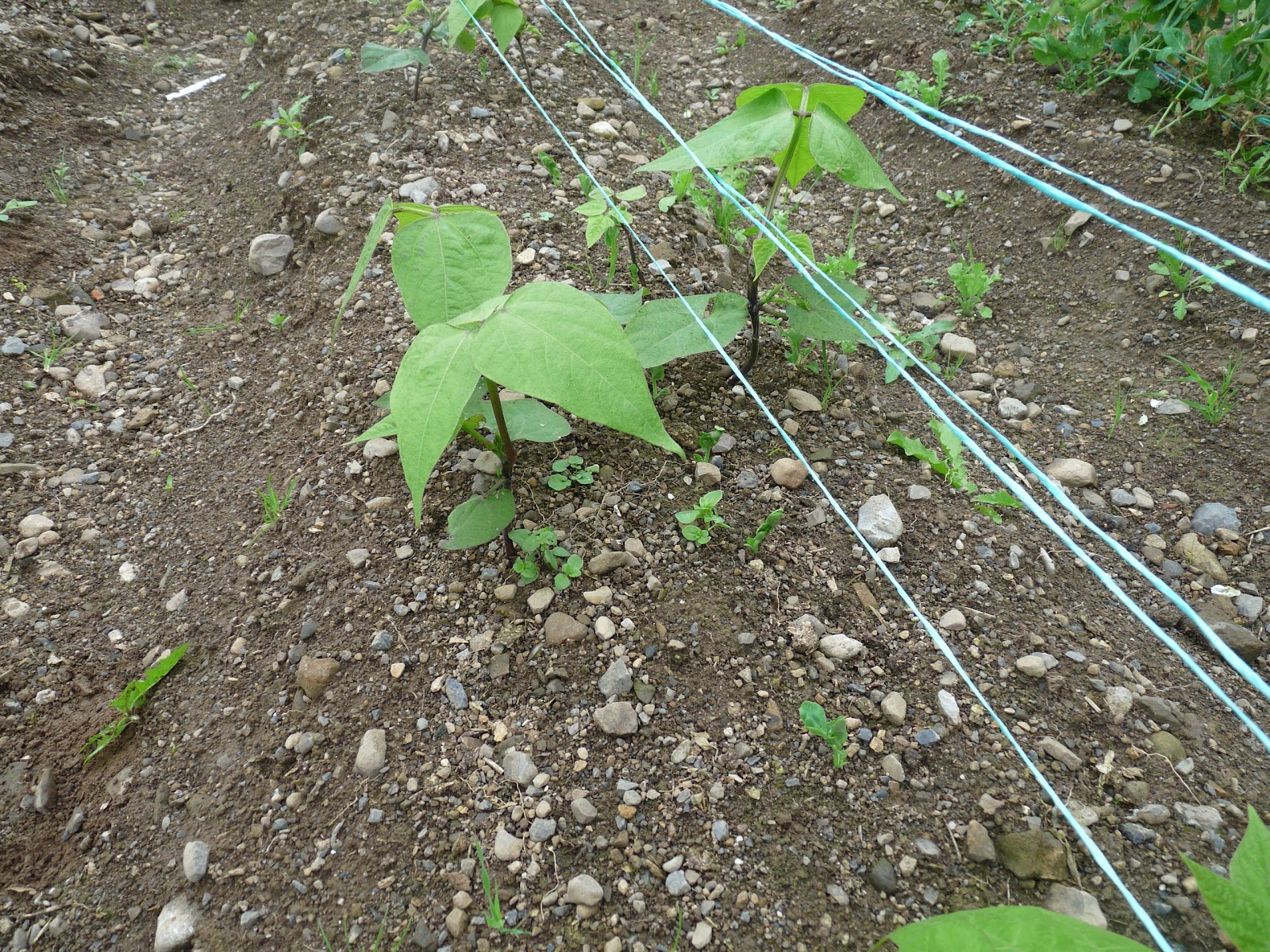
Next up are our climbing frames.
Firstly, our bean plants have proven to be a slight disappointment, growing very slowly thus far.
To cut our losses, Clare's planted pea plants between the beans. They've already started to shoot.

Our pea plants are faring better than our beans. Not as well as I'd like, but they're still growing and yesterday I was able to harvest the first few pods from them.
(The peas were gratefully devoured by Thomas!)

Nearly all the asparagus plants have now sent up shoots, and are growing well. Not that we can touch them for another year!

Our rhubarb plant has maintained it's own at the bottom of the allotment. Not sure what did such damage to one of the leaves, but the problem hasn't progressed.
We've another one that a friend kindly gave us to plant out yet.

Working our way down the other side of the allotment...
Our chives are still alive, which is something, I guess!
Not really much happening with them yet...

For the last week or two, we've had or courgettes under a cloche to protect them from the heavy rains. They're getting a bit bigger now, and hopefully will start producing fruit soon.

Past the courgettes, we've an empty bed.
In the next bed past this one, Clare planted a variety of hardy winter carrot, which have already started to send up shoots.
These are obviously intended to keep us with a supply of carrots when our first lot are finished.

Next up is our white sprouting broccoli.
This takes up about half the bed, the other half we've left fallow until we can plant some purple sprouting broccoli into it.

We transplanted our leeks out a week or two ago, and while we've had one or two that haven't survived, I'm genuinely delighted with the progress of the rest of them.
They seem to be thickening up well, so hopefully we'll end up with a good supply of them.

In the penultimate bed on our little tour, our brassicas grow. We've got the likes of brussel sprouts and kale in here.
As with the rest of the beds, these continue to come along well.
Fingers crossed that I get enough brussel sprouts to sate my appetite come Christmas!

Finally, our potato frame is now full of earth. My intention was to build this up, but I may be too late to do this.
There's been a blight warning issued in the past month or so (the wet, humid weather is ideal for it to thrive), I can only hope that our potatoes haven't succumbed to it.
Finally, the post wouldn't feel complete without a recent photo of the allotment, so here it is.
Thanks to you if you've taken the time to read this post, I hope it was interesting in it's way. As always, please feel free to comment or ask any questions you may have.

The allotment as it looked yesterday evening.